Wednesday, November 4, 2015

Pinot Noir on the Niagara Peninsula

After a long and curious absence the peripatetic visitor has returned. Not me, the visitor is the wine tasting event, which hasn’t graced our living room in almost two years. On this occasion, the theme was Pinot Noir, from “anywhere in the world.” 

Living on the Niagara Peninsula in the heart of Ontario wine country has introduced us to a number of local wines including Pinot Noir. And as expected, wines in this region have a different taste and style than other Pinot-growing regions. Although our guests could bring wines from anywhere, in fact we had wines from Ontario, British Columbia, Oregon, and California (including 2 wines from the same local winery but from differing years).

There were eleven guests and 6 bottles of Pinot. We began as usual with an aperitif wine, a local sparkling Cuvee from Henry of Pelham Winery here in St Catharines, one of Dory’s favorites.

Here are the wines:
A) La Frenz, Naramata Bench Pinot Noir, Okanagan Vally, BC, Canada. $28. 2013, 13.5%
B) The Foreign Affair Pinot Noir “Ciao”, 2009, Niagara Peninsula, Ontario, Canada. $34. 14.2%
C) Keint-He Voyageur Pinot Noir, 2013, Niagara Peninsula, Ontario, Canada. $19. 12.5%
D) King Estate Pinot Noir, Signature Collection, Eugene, Oregon, 2013, 13.5% $26 (US)
E) The Foreign Affair Pinot Noir, 2010, Niagara Peninsula, Ontario, Canada. $34. 14.2%
F) Fog’s Reach, J. Lohr Winery, Arroyo Seco Monterey California, 2012, $40, 14.9%

Pinot Noir can be wildly different depending on where it is from and how the winemaker chooses to make it. It is sometimes light and fruity, sometimes rich and earthy, sometimes showing lots of depth and sometimes fairly simple. Our guests showed a wide range in how they scored these wines - one wine was rated 4/20 by one guest and 20/20 by another guest! Clearly tastes differ according to the preferences of the individual. 

The top wines, based on the scores on a blind tasting sheet, were a tie between B) Foreign Affair Ciao 2009 and F) Fog’s Reach J Lohr 2012. Several of us thought they might be the same wine, because we knew there was a duplicate bottle. Both these wines are on the full side of the taste spectrum, with lots of complexity with flavors evolving over time.

There was (almost) a double - two bottles of Foreign Affair Pinot Noir from different years. The older, 2009 bottle (B), with the word “Ciao” printed on the label, was preferred over the 2010 (E), which scored 5th. The temperature of the 2010 was colder, and that certainly made a difference, but it’s hard to tell if that is the whole story.

The King Estate (D) from Oregon came in 3rd, complex but lighter in body than the top scoring wines. The Keint-He Voyager Pinot from Wellington, Ontario was another lighter bodied wine, fruity, and it scored 4th. Finally, the LaFrenz (A) from British Columbia was light bodied, fruity but not special and it scored 6th.

In the more than 12 years of doing these wine tastings I’ve come to be less interested in the numerical rankings and more interested in how the rankings express individual taste preferences. My take away from this is that bigger taste profiles, with complex flavors that evolve over time, are preferred by more people. I like those bigger wines, no question. But I’m also learning to appreciate some more subtle wines. I liked ALL these wines, and it was really interesting to see the variety. 


Tuesday, November 12, 2013

Sparkling Wines in Shanghai

Meal:
Smoked Salmon on Orange slices (Phillip), 
Vietnamese Spring Rolls (Nar), 
Home made Fusilli and Cheddar (Dory), 
Green Salad (Dory),
Tiramisu (Takeout)

Wines Tasted:
  1. Lindeman's Bin 25 Brut Cuvee, 12%, ¥165, 
  2. Seaview Brut,11%, ¥138
  3. Jacob's Creek Chardonnay Pinot Noir, 11.5%, ¥150
  4. Perelada Brut Reserva Cava, 11.5%, ¥148
  5. Cava Parxet Cuvee 21 Brut, 11.5%, ¥130

Overall Impressions:
These wines were all in the range of $21-$26 USD, but as with everything in China, you don't always get what you pay for. Our guests were fairly consistent in uniform liking the Lindemans - it had a noticeably more complex flavor profile, the flavor changed in the mouth (in a good way), and there was a pleasant aftertaste. One of our guests was from Melbourne, and he said that Lindemans at home was a a $5 bottle of wine! I think that's the price of being a wine-imbibing expat in China.

The Seaview and the Jacobs Creek wines were OK, and they would be fine at a party where they would not impress or offend.We were reminded of "house sparkling wines" while drinking these two.

One guest remarked that the Perelada had an "aspirin" flavor; another noted a metallic aftertaste. These are not desirable qualities in wine.

The Parxet Cava scored the lowest, although not by much, and we all thought that "there's nothing there", no flavor, no aroma, really, not much going on at all.

The most interesting thing about the evening was the pairing of food with sparkling wine. In our house we usually think of sparkling wine as an aperitif, something to start the evening.  In fact, when we host these wine tastings for other wines we always start with a glass of some sort of sparkling wine to get the taste buds "in the mood", so to speak.

The winners in the food pairing department were the smoked salmon on orange slices as an appetizer and the Mac and Cheese. Several people noted that after the salmon and oranges the wines "woke up" and the flavors were both better and more plentiful.


Wednesday, October 30, 2013

Cabernet Sauvignon from Chile

Chilean Cabernet Sauvignon wines

Finding a reliable table wine in Shanghai is still a problem but our recent tasting of Cabernet Sauvignon from Chile was a delightful surprise. As usual, we chose a grape (Cabernet Sauvignon) from a particular region (Chile). Each guest brought a bottle of wine that met that standard and sold for no more than ¥160 (about $26). Each bottle was wrapped and served blind, and we tasted each of them in turn.

Last Spring we tasted Shiraz from Australia and were largely disappointed. None of them were really very good. By contrast, these Chilean Cabs were all pretty good (with the exception of the corked wine, of course). We had a duplicate pair of wines, and one of them was corked. Other than that, everyone agreed that all wines were certainly drinkable and even enjoyable. With the exception of the winning wine (and of course the corked wine) all wines were good, solid, enjoyable Cabernet Sauvignon wines.  Any of them would be fine with an inexpensive dinner, at a party, or as a 'second' bottle of wine.

The winning bottle, by score and by unanimous acclaim, was Carta Vieja Prestige.  It was a much more lively wine, with flavors that evolved over time, from the first whiff of the aroma to a lingering aftertaste, minutes after the wine had been swallowed.  This was a wine that wants you to pay attention to it, to savor each sip and to pause before once again bringing the glass to the lips.  It was a pretty well balanced wine, and curiously, does not have any big flavors that predominate.  It had berry, wood, a bit of leather, and cherry, but nothing overpowering, and no stand out flavors.

Here are the wines we tasted, in the order we ranked them:
  1. Carta Vieja Prestige
  2. Santa Rita Reserva
  3. Concha Y Toro Frontera
  4. Cousino Macul Antigua Reservas
Not ranked
  • Miguel Torres Emblema
  • Miguel Torres Santa Digna Reserve


Dory cooked an excellent meal of Fusilli with mushroom cream sauce,  green salad, bread, and chocolate mousse for dessert. 

Monday, June 10, 2013

New Zealand wines in Shanghai


Earlier this spring we attended a wine tasting at the Roosevelt Hotel, which featured wines from New Zealand, particularly one Sauvignon Blanc and three Pinot Noir wines. The cost was ¥120 each, which included snacks, the wines, and of course views of the Bund and Pudong Financial center across the river. It's always worthwhile going downtown, and this seemed interesting, so we took the shuttle downtown and walked to the Bund.

We enjoyed the wines (more on those in a minute) enough that we bought some of them and had them delivered. In the process we were able to get samples of all four wines so that we could replicate the wine tasting at home.

Here are the wines:
Omni Hills Limestone Ridge Sauvignon Blanc, New Zealand, 2011, 13.6%, ¥130 (about $21.50) omnihills.co.nz

Omni Hills Limestone Ridge Pinot Noir, New Zealand, 2011, 14.4%, ¥200 (about $33) omnihills.co.nz

Miners Daughter Reserve Pinot Noir, North Canterbury, New Zealand, 2011, 14%, ¥268 (about $44)

Pyramid Valley Vineyards, Growers Collection, Cowley Family Vineyard Pinot Noir, 2010, 14%, ¥335 (about $55) Wakari, North Canterbury, New Zealand

The Omni Hills Sauvignon Blanc was a real treat. It was exceptionally well balanced, with the citrus flavors common to Sauvignon Blanc, but with some additional roundness, almost a vanilla hint that made it less acidic and very versatile. I generally like the grapefruit flavors of Sauvignon Blanc, but this wine felt a bit more nuanced, more elegant. It has a long flavor profile, developing in your mouth and then slowly melting away, leaving a suggestion of vanilla, a touch of mineral, and mixed fruit. It has slightly too much alcohol for my preference, but it is well balanced. The only problem is that at 13.6% you have to think about how much you can have! Very nice wine, and very nice as an accompaniment to Chinese food here in Shanghai. We're looking forward to drinking more of this.

Omni Hills was also represented by a very nice, light-bodied Pinot Noir, their Limestone Ridge Pinot at ¥200.  This wine had a delightful, delicate, long flavor profile, with cherry and raspberry flavors. The flavors are so delicate, so nice, and it's a bit of a shame that it doesn't have more body. Pinot Noir can be made in a wide variety of styles, and the full-bodied wines are so good, that they tend to be what many of us look for in Pinot Noir.

(As an aside, a colleague was raving about an Erath (Oregon, Willamette Valley) Pinot Noir he had had that was stunning. He went out and bought several bottles of Erath, only to find that, while good, it wasn't the same full bodied Pinot he had fallen in love with on his first tasting. The fact is, there can be excellent light bodied Pinot and wonderful full bodied Pinot, and if you are expecting one and get the other, it's possible to be disappointed.  Just sayin.)

Miner's Daughter made a very tasty Pinot Noir with a wonderful aroma, a full body, and … then it falls off a cliff. Once in the mouth, the flavor turns acidic and somehow stops. When Dory and I tasted this at the Roosevelt, I didn't even finish the sample pour.  On the other hand, when we held our own wine tasting recently, it ranked higher than the Limestone Ridge Pinot.  So, some of us liked it better than, well, than I did. I wanted to like it but I just found it had a bad finish.


The Pyramid Valley Pinot Noir, in contrast to both the earlier wines, was awesome.  Of course, at more than $50 it certainly ought to be good. And in fact I loved it. It has a full intriguing aroma, a full bodied first taste, and a lingering aftertaste. It was multi layered, with fruit, cherries, and earthy flavors. 

When we had our wine tasting at our house, re-creating (without fireworks, sadly) the original, the results changed a bit. Dory and I still held to our original preferences, but our guests thought the Miners Daughter was very good. So, there you go - personal taste trumps all.

We were happy to find these wines, and very happy to be drinking them in Shanghai. It is available through http://globus-wine.com/.

Sunday, March 24, 2013

Bordeaux disappointment in Shanghai


Our second wine tasting in China confirmed what we found last time: it's hard to find good wines at the $26 price point. There are some, but it is difficult. That's the bad news.  The good news?  The quiche was great!

Our latest wine tasting was a bit of a surprise - we had been wanting to do this but kept letting planning get in the way. So on Wednesday we announced that we were going to do a wine tasting and emailed past participants and a few others who had expressed interest. By Friday we had our 8.

Because it was short notice the easiest wine to get around here, by far, is Bordeaux. The French have a firm foothold in the Chinese market. So that's what we were drinking, Bordeaux, priced at up to ¥160 (about $26 USD).

In the US we choose the price point of $20 because we were interested in finding good tasting wines that wouldn't break the bank.  Even everyday wines ought to taste good. So that was our mindset. In China prices are higher and it seemed that we could find a variety of wines at ¥160.


Sadly, these wines were mostly bad. It is as if we were looking for a drinkable wine at $6 instead of $26.  Here is the tally:
Bordeaux, La Buissiére, 2011, 13% ¥unrecorded, wine "D" scores from 4.5-9, average total 6.5/20
Mouton Cadet, Rothschild, 2009, 13.5%, ¥135, wine "C", scores from 1.5-13, average total 7.5/20
Bordeaux, Chateau Dudon, 2009, 13.5%, ¥118, Wine "B", scores from 6-9, average total 8/20 
Bordeaux, l'Union de Producteurs, 2010, 14%, ¥158, Wine "A", scores from 9.5-15, average total 13/20

So, wine "A" was a winner, and pretty closely scored by everyone. We bought it at Carrefour, prompted by a French salesman who told us he drank it at home growing up. And we believed him, but whether true or not it was a good wine.

After finishing our sampling, I brought out a bottle of Cotes du Rhône, Chapoutier, 2010, 14%, ¥158.   Dory had found this and we liked it.  Everyone at our Bordeaux tasting also liked it, better than at least 3 of the four bottles, and certainly competitive with the best Bordeaux.


The reason we do these wine tastings is to have fun but also to learn  about various wines, and one of our guests commented that the Cotes du Rhône was spicier, a really different taste. So I was pretty happy that even though we are not finding affordable everyday wines, we are certainly learning something!

Sunday, January 20, 2013

Shiraz Tasting in Shanghai


The wine tasting was clearly a success, but it wasn't due to the wine.  At least not in my opinion. 

It has been over a year since our last wine tasting, Reisling, which we had in Munich. In the interim, we moved back from Munich and then on to Shanghai. Munich was mostly a beer culture, but a variety of good wines were available and at reasonable prices. Shanghai is much more cosmopolitan than other parts of China, but we had been warned that wine was expensive and kind of hard to find. The Chinese are apparently getting into wine, with wine stores and wine offerings in the expat shops. Still, wines are more expensive here than in the US and much more than in Europe.  I think it's a question of demand rather than taxation, but it's still a bit of a mystery.

We chose to have a wine tasting with Australian Shiraz, (no blends) with prices up to ¥160 (about $26).  In the US we could find a number of pretty good wines in that price range. As before, guests shop for a wine that fits the parameter, and when they arrive I wrap the bottle up and so we are not swayed by marketing or price.

As in Munich, we found 6 colleagues who shared an interest in wine and who we thought would be fun to spend an evening with.  We were not disappointed.

Here are the wines that made an appearance:
A Jacobs Creek Shiraz,  ¥125, 2009, SE Australia, 13.5%
B Nederburg, ¥105, 2010, from South Africa, 14.5%
C Andrew Peace, ¥125, 2008, Barossa, 14%
D Peter Lehmann, ¥130, 2008, South Australia, 14.5%
E Mr Riggs The Gaffer, ¥158, 2009, McLaren Vale, 14.5%

One couple brought a bottle of Nederburg Shiraz from South Africa instead of getting something from Australia, and it turned out to be a favorite.  It was richer, had more of the spice and fruit flavors that we associate with Shiraz, and had a longer, fuller finish. As it happened, it was also the cheapest at ¥105.

The other bottles, all Australian Shiraz, tasted to me like an adequate table wine. Clearly Shiraz, but nothing special. Not particularly full flavors, not especially long lasting, not surprising or notable. Just adequate. The Peter Lehmann, at ¥130, was the worst, with most of us proclaiming "Meh" to this Barossa Valley wine. Go figure.

We ordered Indian take out, and it went well with the wine and predictably made every wine taste better. Plus ordering take out food was a lot easier to manage.

We chose Shiraz because it was the closest of the major wine producers, and Australia has a long commercial relationship with the Chinese. Plus we like Shiraz, it's the middle of winter and it's cold outside. Why didn't we find better wines from Australia?  It could be the price point was too low, but the SA wine was cheaper and noticeably better.  It could be that the Chinese market likes a different style of wine than we like.

But we had fun, and that's what counts.

Oh, and one more thing. Dory insisted that we start the evening with a sparkling wine. She chose an Australian sparkling wine called Seaview Brut. It was very good, and a perfect way to get things going. I'd definitely have that again.

Stay tuned. It's possible that we will have more wine tastings in the future!

Tuesday, November 15, 2011

Riesling


Dory here, guest-blogging on Dirigo Wine. Having been living in Munich now for well over a year, we finally decided it was time for another tasting. While we missed our usual crew, we had a number of enthusiastic tasters who were willing to join the fun last Saturday night. One of them, our pal Gemma, a young Yorkshire lass, can’t drink reds (poor dear) so we decided on Rieslings for a first go-round, since it’s native to these parts and all. Rounding out the Tasty Tasters: Susie from Oz, Susan from Scotland with her out-of-town friend Tricia from Canada (but currently teaching in Brussels), Sanna from Finland via Munich, the English lad Jonathan, Gemma’s visiting mom Jackie, plus Dave and me (and Sanna’s adorable dog Feliz, who is Swedish). It was a very lively crowd.
We did a few things differently than our tried-and-true Soto format. Since Riesling is billed as “hands-down the best food wine in the world,” we made it a potluck and there were all kinds of interesting foods: two kinds of hummus, a typical Alsatian quiche, pear-gorgonzola-walnut melt, cheese scones, a gorgeous cheese and dried fruit platter, oven-roasted root veggies with an apple juice/Riesling glaze, and for dessert, flapjacks (which, in the UK, turn out to be sort of a granola bar affair). At the end of the meal, we had to concur that Riesling seems to go with just about anything.
But I am getting ahead of myself.
We stuck with our usual format of asking people to bring a bottle of Riesling from anywhere in the world, priced under €20. As most of the Tasties were neophyte tasters, we started with a quick YouTube video on how to taste wines:
Then we broke out a new wine notes page – not a scoring sheet, as Dave was quick to point out, but a simple way to summarize what we were tasting. We also had copies of the wine wheel to help us think about what we were sniffing and sipping. Dave had wrapped up the bottles as they came through the door and in an effort to keep things both anonymous and lively, each bottle was christened with the name of an American football team. We were restricted to one wine glass a piece, since that’s all we had, so we tried each wine one at a time, the first round without food and the second round with heaped plates before us.

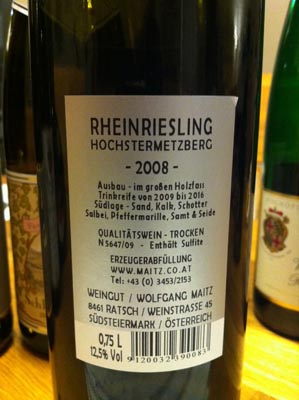
We sampled eight bottles all together, ranging in price from €6 to €20. Two people brought the exact same bottle, so there were 7 different wines, 6 of which turned out to be from Germany and one from Austria. Riesling has the reputation of being on the sweet side, but these examples did not fall into that category at all. Common descriptors included citrus-y, tart, sour, grapefruit, sharp, lemon-y, but these tags were balanced with characterizations ranging from marzipan, floral and toffee to mineral-y and kerosene. We found that all of them were better with food – some were better with one type of food than another, but at least one was deemed by everyone to be good with everything.

In the end, it was the Austrian that won our hearts and mouths, a 2008 from a winery called Maitz (but known at our table as the Colts, for the evening anyway; I must note that the wine did a lot better over the weekend at our house than the team did on the gridiron, however). And interestingly enough, one of the words that popped into several of our minds when we first sniffed this one was kerosene. But the taste: smooth, mango, butterscotch, full, minerals, pineapple, rich, to highlight a few of the reactions to this very nice bottle. And wouldn’t you know it: it was the most expensive at €20.

So what did we learn? That there’s a lot of decent Riesling to be had, and that you can have it with pretty much anything you want to eat (which therefore makes it a safe bet for our gal Gemma). And the gang loved it. Next up: Cabernets in January – something to look forward to after the holidays.

Post Script:
It actually turned out to be a big wine weekend for Dave and Dory because the Forum Vini was in town. On Sunday afternoon, we rode the U-Bahn to the north of the city and paid €17 a piece to taste wines from all over the world. Such a deal! Shipping wines to private customers is the norm here in Germany, and we found ourselves ordering bottles from South Africa and France, a great rosé Prosecco, and, as it turns out, a Riesling from Austria. So the moral of the story is: if you’re looking for a nice white, give a Trocken (dry) Riesling from Austria a try.

Saturday, January 2, 2010

New Years Wines - Oysters and wine

Here's our menu for New Years eve: Fresh Local Oysters, Gravlax with greens, Lobster stew, Chicken Marbella with orange scented Couscous, and handmade chocolates.

The wine list started with Veuve Clicquot Champagne with the oysters, followed by Chateau Menaut Sauvignon (one of those white Bordeaux I've been raving about), 2004, $13.80, 12.5%.  We then rested for quite a while before moving on to the Chicken Marbella and two Spanish wines, Castillo de Fuendejalon Crianza, 2006, 12.5%, a blend of Grenache (75%) and Tempranillo (25%), my favorite, and Evodia, 2007, 100% Grenache, 14.5%.  These were both excellent, but my favorite was the Crianza - it seemed a bit smoother and more complex.

Our meal lasted over 3 hours, with frequent rests, and was a great time with friends.  The oysters had a story with a happy ending.  My wife had arranged with a local grower to buy 4 dozen oysters from her for thhis meal.  When we called to arrange the pickup, we learned that our reserved oysters had been sold!  After several frantic calls we found a place in Damariscotta.  We stopped by in the early afternoon - the oyster delivery hadn't been made yet.  We wandered and shopped in Damariscotta, and after 45 minutes we got our oysters.  48 fresh, local oysters.  While we were buying them the store sold 20 dozen - obviously we weren't the only ones with this idea in mind!

Because of a snow storm one couple wasn't able to make it to our house, so that meant 4 dozen oysters for 4 people.  They were great!

Wednesday, December 16, 2009

White Bordeaux part 2

For some reason I've gotten myself on a white Bordeaux kick.  Generally I've been a red wine kinda guy, and some of my friends either really prefer whites or simply don't drink red wines.  Usually we drink Pinot Grigio or sometimes something more obscure like a Gavi.  Chardonnay can be great but often is not, and Chablis, well, we haven't found good Chablis on a regular basis.

Which leaves us with drinking or wishing we were drinking red wine.  Of course, there are lots and lots of varieties of excellent wine, and it is just silly to think that we can't find them.  On a whim recently I picked up a bottle of Cuvee Occitane by L'Archet (2006, 14%, $18-$20, imported by Indigo Wine Group)  It was a great accompaniment to our fish dinner,  rich, complex, not too 'summery', simply delightful.  It is made from a blend of Marsanne, Roussanne and Grenache Blanc.  In addition to those, typical grapes for this region include Semillon, Savignon Blanc, and Muscadelle.

Tonight we had haddock, roasted Butternut Squash, and a wonderful winter salad with fresh spinach, pear, goat cheese, and toasted pecans in a raspberry vinaigrette.  The wine was the remains (leftover, opened last night) of a bottle of Chartron La Fleur Bordeaux (2008, 12%, $9, imported by MS Walker).  Excellent, particularly under circumstances that are arguably "not the most optimum".

So, I'm all excited by this discovery of a nice white wine, at all price points, that I can enjoy and be happy to drink with my non-red-drinking friends.  Give it a try, let  me know what you think.

Cheers!

Saturday, December 12, 2009

White Bordeaux

 I'm visiting my father in Oregon and last night  we enjoyed a nice bottle of White Bordeaux. Chateau Mauros, 2007,$9.75, excellant with trout!

More on White Bordeaux to come.

Sunday, December 6, 2009

More on Nero d'Avola

Just to add a post-script to the wine tasting blog of Nov 21, I've found another bottle that I think tastes quite good.

I Rustici Nero d'Avola, 12.5% imported by Specialty Marketing Group, Canton, MA,  about $10-$12
is an excellent wine, smoother than many of the others we tasted in November but full of flavor.  Also terrific with food, particularly (no surprise) Italian foods.

I think it's a great value and one of the better Nero d'Avola wines we've tried.

Wednesday, December 2, 2009

10 gifts under $20 for the wine lover in your life

It's the holiday season, so I'm blogging about 10 gifts for the wine lover in your life.  Eight of them can be had for less than $20, one of them (depending on where you live) might be had for less than $20, and the last one arguably could be pretty expensive.  But fun!

So here we go:
1) Wine aroma wheel, $6 plus shipping,  http://www.winearomawheel.com/  We use this clever tool regularly in our wine tastings.  It helps to identify tastes, flavors, and aromas, and it can be a fun ice breaker when you start talking about these various flavors.  It's a great device for helping all of us identify and describe what we are tasting.

2) Essential wine tasting guide, $12  http://www.essentialwinetastingguide.com/  This is a pint sized version of the wine aroma wheel plus a lot more in a wallet sized, cleverly folded booklet.  It brings a lot of thought and advice to your wine tasting experience.  Plus you can bring it with you anywhere.

3) A good wine reference book.  I use The Wine Bible, by Karen McNeil, $12, http://www.amazon.com/Wine-Bible-Karen-MacNeil/dp/1563054345  I find it extremely interesting to read about various wines and regions, and Ms McNeils book is thorough and easily readable.  You should have a copy (or something similar) wherever you drink wine.  When you open a bottle of wine from a new region, or are drinking something you really like, stop and open the book and read about it.  It really helps you understand the wine, where it came from, and what you might be tasting.

4) Glassware.  Glassware makes a difference in what you taste, and glasses break.  All of us can use more wine glasses.  For our wine tastings we've managed to buy about 60 pieces of mostly-the-same shape stemware.  This way you can compare two, three, or more wines at the same time with your group.  We bought our stemware at a TJ Maxx store, but the most important thing is to have a good shape.  A tall stem with a wide bowl that tapers toward the rim, such as a bordeaux shape, is my preference.  Plus it looks really cool to look at a table full of stemware.  And don't worry if it breaks.

5) OK- this one's pretty boring.  sorry.  Non scented candles and non scented dish soap.  Boring.  But you know, it makes a difference.  Scented candles, which are wonderful in other situations, can ruin the flavor of wine in a wine tasting.  Move the candles away from the table, or light up those beautiful non scented ones.  Ditto for the dish soap.  Most dish soaps are highly scented and can be tasted along with the wine.  Sounds disgusting?  It is.

6) Wine!  This suggestion is probably the most obvious, but there are lots of good wines out there for less than $20, and more for more money as well.  There are two ways to do this: a- remember what your wine lover likes and buy it, or b- ask a wine merchant that you trust what they might suggest.  Be prepared to answer questions about what styles of wine you are looking for - red or white, sparkling, old world vs new world, etc.  think about what wines have been successful in the past.  My suggestion for a red?  Mara, by Cesari, a "ripasso" style wine, sometimes called a baby Amarone.  Delicious.

7) Port.  Most folks like Port, and we often forget about it when buying wine.  You can find a delightful Port for less than $20.  Ask your wine store for suggestions.  I'm fond of Tawny Port. but I like them all.  If you are intrigued by Port, there is a whole arcane world to learn about.  Port and a good reference book would be a thoughtful, enjoyable gift.  There will be a test afterword, so be prepared.

8) Sparkling wine.  We can't call it Champagne unless it comes from that region in France, but there is a lot of fun and drinkable sparkly wine available from all over the world.  We've been keen on Gruet from New Mexico (of all places!) but we also like Cava from Spain and Prosecco from Italy.  Spend more to get better wine.  And wait for the sparks to fly!

9) Visit a winery.  You can learn so much by visiting a winery, tasting the wines, and learning about what the wine makers were hoping to achieve, and it's fun.  Be sure to designate a driver for the return trip home.

10) OK, this is my current travel Fantasy: Kalahari and Cabernet.  We fly to Windhoek, Namibia, and spend 5 days visiting the Kalahari desert, Big 5 animal safaris, and cultural excursions.  Then, we transit to Cape Town, South Africa, and head to Stellenbosch, center of the renowned wine industry in South Africa.  We'll spend 5 days visiting wineries, tasting the red and white wines of this region.  We'll enjoy a classic SA Braai, the meat lovers grill that sets a standard for meat eating, accompanied by Pinotage, Cabernet, and other red wines.  Great food for vegetarians as well, and always great accommodations and fun.  Hey, it's my fantasy.  Likely more than $20.

Happy holidays, be safe, and enjoy yourself responsibly.

Saturday, November 28, 2009

Thanksgiving wine 2009

My best intention was get and serve only American wines for thanksgiving, and I had just the array in mind: We'd start with a sparkling wine from Gruet in New Mexico (winner of a blind tasting several years ago and reasonably priced), Followed by an Oregon Pinot Gris for the appetizer course, and finishing up with an Oregon Pinot Noir with the big bird. (Not the yellow big bird, of course.)

Here's what we wound up with:
Adelsheim Pinot Blanc, 2006, Oregon, 13.6%, $20.75;
Benton Lane Pinot Noir, 2007, 13.5%, $25.65;
Segura Viudas Cava, 12%, $22.29

The Adelshiem was by far the best, complex, interesting, complementary yet able to hold its own against the meal. The Benton Lane Pinot Noir was a disappointment to me. It lacked body, was more like a Nouveau Beaujolais than a complex Pinot Noir.

Now, I know I can get "big" jammy Pinot from California, but I like the complexity of the Oregon Pinot. And I've certainly had excellent wines from Benton Lane. Just not this one. I have discovered that the better Oregon Pinot Noir costs more money, and to get a reliably good wine you often have to pay more than $40, sometimes much more.

The cava was good, and I think it's a good value. Certainly worth having on hand.

Nero d'Avola - Nov 21

Nero d'Avola

Nero d'Avola, the dark red grape from southern Sicily, was front and center for our most recent wine tasting. We've enjoyed this wine for several years, finding it good with food and tasty while being very affordable. This time we each brought a bottle and tasted them blind, before eating and then again during our dinner.

But first, the appetizer: Cheeses from Appleton Creamery: “Camdenbear” a soft cheese made from cow milk, and served with a cranberry chutney from Half Moon Farm; a three milk “tomme” from goat, cow, and sheep milk; and a raw sheep milk cheese, aged over 120 days and “closer to a Romano”. We shared a bottle of Beaujolais Nouveau, ($9.99, 2009, Georges Duboeuf, 12.5%). Not normally my preferred wine, this years version was better than I had expected, and was a good way to start the evening. And the cheeses? Awesome: a meal could be made exclusively from them, and we would all have been happy!

Now, the wines:

Fondo Antico Nero d'Avola, 2006, 13.5%, $10.99, imported by Ideal Wine and Spirits. (yellow)

Contrada Ragabo Nero d”Avola, 2006, 14.5%, $12.99, imported by Small Vinyards LLC. (green)

Terre Nero d'Avola, no year indicated, 13%, $10.65, Imported by Leonard Locascio. (orange)

Villa Pozzi Nero d'Avola, no year indicated, 13.5%, $16.99, imported by WJ Deutsch and sons (blue)

We normally are quite fond of this wine. It has lively flavor (berries, cherry, some spice) and enough tannin to make it good with food. But these wines were “all over the place” as one guest noted. It was hard to get a good sense of what the wine really tastes like from the four samples we had. Comments ranged from “harsh” to “sweet”, from “bland” to “comfortable, completely different”.

One wine, the first we tasted, (Fondo Antico) was universally panned. None of us really liked it, the tannins were too strong and no clear flavor emerged. The most charitable thing to say was that it would be a good pizza wine, or a good 2 Euro/bottle wine in Europe.

The other three wines were all different. Scores were closely matched, with the Villa Pozzi narrowly (should I saw “nero-ly?) edging the others for overall favorite. There were hints of blueberry in the flavor, and it had the most balanced tannins.

My favorite was the Terre, which was also the least expensive.

As expected, the wines became much, much better with food. We ate a roast leg of lamb, with roasted root vegetables and carrots cooked in cream. The wines had good body to stand up to the strong flavors, and even the least Fondo Antico was pleasant with the meal. But the others all came into their own – really adding to the meal and tasting much better in their own right.

We had fun, we enjoyed a great meal, and we talked about the next get together, whenever that will be!

Tuesday, November 3, 2009

South African Sauvignon Blanc

What a day. I noticed this morning that our freezer, a small floor model, had a puddle of ice near the door. Not good. I closed the door, made coffee, and waited for the caffiene to kick in. Cautiously I opened the door and looked at the freezer again - the ice puddle was still there. Worse, everything inside the freezer was covered in rime ice, fuzzy crystals of ice obscuring the post-it notes with the contents listed. I was afraid that another cup of coffee wasn't going to be the ultimate solution, but on the other hand it certainly couldn't hurt.

In the process of defrosting the freezer I discovered some lost items - some soup, Caldo Verde, that I love when it gets cold, and a small piece of salmon. I chose the salmon for the evening dinner. My usual cooking method is grilling, but tonight I decided to poach the salmon, and the recipe that google provided included 1/2 cup of sauvignon blanc. I got a bottle out of the cellar and poached the salmon, made Basmati rice, and a fresh (local Bowdoinham) spinach and tomato and mushroom salad.

Now, I always prefer reds to whites, and I didn't think too much about what wine I had chosen. But when I tasted it, wow! Rich, complex, long lasting, complementary to the meal, it was great. The wine was a South African Sauvignon Blanc, 2007, from Graham Beck. I don't remember where I got it or how much it cost, but it wouldn't have been a terribly expensive bottle. A perfect complement to my 6 month old frozen salmon ( a good wine can really make a meal come together, like the right rug in a room).

South Africa has been producing some very distinctive and quite drinkable wines, at reasonable prices. I'm particularly fond of the Cabernet Sauvignon wines, and now I'm keen on the Sauvignon Blancs.

Tomorrow I'll see how it goes with Caldo Verde soup.

Thursday, October 29, 2009

I've been traveling, and am now very happy to be back at home. I was in Haiti, where the drink of choice was Rum or beer.

So now, at home, I grilled a small steak, cooked some potatoes and sauteed - very briefly - some Brussel sprout tops. I looked at the wines I had and went for a 2006 Napa Merlot, Annabella, from Oakville, 14.5% This isn't a wine I would normally drink, usually favoring Italian wines. And truthfully, I would have opened a Chilean Cab if I had one in front of me. But this was a very nice, well balanced wine.

Merlot got a bad rap for becoming too popular, but it is a wonderful flavorful wine. It goes to show you - revisit soem of those old wines we used to drink. (Well, maybe not the gallo hearty burgundy....)

Saturday, October 17, 2009

Fuel Restaurant

Last night we ate at Fuel, a restaurant in Lewiston, Maine. Our first visit won't be our last! We chose a sampler, where the chef chooses four courses. We were asked if we had any strong preferences or particular needs. To accompany this meal we choose a wine sampler - 4 wines chosen to go with the dishes we were eating. Both the meals and the wines were well matched and delicious.

We started with a glass of NZ Sauvignon Blanc, which came on with a pronounced grapefruit and straw taste. It preceded the first course, a pumpkin risotto with fois gras and a veal reduction sauce. The risotto was delicious, soft, creamy, slightly nutty, and accentuated by toasted pumpkin seeds. The Sauvignon Blanc went well with it, but our only complaint was that we received the wine before the food and as a result the wine was finished before the food.

The second course was a tuna carpacio with a "watermelon radish", something I had never seen before. A french Pinot Noir accompanied this course, a little too fruity at first but magically perfect with the tuna. This was almost a Japanese presentation, on narrow rectangular plates and artfully arranged. Possibly my favorite dish of the evening.

Next the wine steward arrived with a choice of either a Cline blend or a BV California Cabernet. We chose the Cline and were not at all disappointed. The rich, spicy, full bodied wine was great with the next course, a combination of pork ribs, pig tongue, and pork belly, all cooked perfectly, extremely flavorful and rich. Very Rich.

Slowing down, we were served a chocolate torte that was incredible, accompanied by a glass of "Port" from the Paso Robles region in California. I an a big fan of real port from Portugal, but I must admit this was quite well done and a great foil for the rich chocolate.

The service was first rate, both the chef Justin and the wine steward stopped by the table to chat and see how we were doing. Our server was attentive but not obsequious, always appearing just as we were ready for the next thing.

We had one very minor quibble with our dining experience: it is a loud space! Although there were a few empty tables, most seats were filled and it was loud. The tables are spacious, meaning that we found ourselves having to speak up (and add to the din) just to hear each other.

Friday, October 16, 2009

Nero d"Avola - Nov 21

The next wine tasting is Nov 21, and the wine is Nero d'Avola.

We've been drinking this wonderful wine for several years now. It's often a great value, with extremely drinkable wines available for between $7 and $12. Recently prices have been going up, and I think the market is catching on to what a good value this wine represents.

This is a dark red wine from Sicily, moderate tannins, excellent with food or by itself. Some wine sites compare it to Syrah, with big fruit flavors and cherry, plum, raspberry, and spice notes.

We're planning to have an Italian meal to accompany this wine, because, really, why not?

Taste some and let me know what you think.

Sunday, October 4, 2009

Birthday wines

Dory bought some wines recently and included a couple of bottles of Amarone, a 2006 and a 2005. Unfortunately, both bottles are gone to the recycling station, but it's fair to say that both were good, the 2005 much better. These wines didn't have that strong raisin flavor that some of them have, but they were both complex, long lived wines. We had them with grilled steak.

Then, the NEXT night, we had a Brunello di Montalcino 2003 that I received as a birthday gift. Wow! I don't normally drink many Brunellos, because of the price and because at that price I like Barolo or Amarone. Wow. It was awesome. Complex, not strong tannins (which we like, but this wine was extremely well balanced), long finish... just a wonderful experience. We had it with roast chicken and roast vegetables.

Sunday, June 14, 2009

White Wines for Fish

Every body knows that white wines go with fish, right? It's been accepted wisdom for ages. But which whites go with which fish, and are all whites equal? Our Dirigo Wine group decided to find out.

Normally we choose a grape and a region (the last one was Cabernet Sauvignon from Chile) and ask each couple to bring a bottle, costing less than $20. I wrap them up and we do a blind tasting. This time I assigned a grape for each couple to bring. The assignments were:
  • Sauvignon Black
  • Chardonnay
  • Pinot Gris
  • Gewurztraminer
  • Viognier
In the end we wound up with all of these (two bottles of sauvignon blanc!) and a bottle of Muscadet as well.

The meal was fantastic. We started with a variety of artisinal goat and sheep cheeses, followed by fresh local swordfish on the grill, accompanied with an orzo salad and followed by a salad of fresh garden greens. Desert was lemon cake with fresh strawberries.

We poured samples of each wine and started tasting and making notes. The cheeses were accompanying this course, and we all noted that cheese makes any wine taste better. Our first wine to taste (Orange yarn) turned out to be Pinot Gris (Alsace, Cave de Turckheim, 2006, 13%, $17). It was beautiful in the glass, and people commented on fruit and citrus flavors. Several of us guessed (incorrectly) that this was a Sauvignon Blanc. Many of us drink Pinot Grigio as a regular everyday white, and I think that what threw us was that this was a French wine rather than Italian or Californian wine.

The second wine to taste (Blue Yarn) was a Sauvignon Blanc (Sincerely, South Africa, 2007, 12.5%, $13). When it was first sipped it had a nearly overpowering and unpleasant smell of asparagus. After it had been open a while it had a sooty taste, and with the fish (by now it had been open about an hour) it mellowed out and was very enjoyable. It won the 'most improved' award.

Next on the list was a Fume Blanc (Green yarn) which fooled all of us because the taste of oak made us think (incorrectly) this was a Chardonnay. This bottle (Ferrari-Carano, Sonoma, 2007, 13.9%, $18) featured a Sauvignon Blanc grape which had been fermented in French oak. It was full bodied and I really enjoyed it with the swordfish.

When we got to tasting the Gewurztraminer (Fetzer, 2007, 12%, $11) we noted that the sweet taste offset the spice of a peppery sheep cheese. Other than that, we all found the Gewurztraminer to be too sweet and generally not to our liking (I have had Gewurztraminer wines that were not so sweet and syrupy, but this wasn't one of them.)

The next wine (yellow yarn) was a Chardonnay (Clos La Chance, Monterey County, Ca., 2006, 13.5%, $13.50). This one boasts that it is entirely unoaked – I thought it was a Sauvignon Blanc! It was very nice with the swordfish, not assertive, enjoyable.

It is difficult to keep tastes and flavor profiles straight when there are many wines before you – we were pouring no more than 2 oz of each and trying to describe each of them. But, it gets hard. The following wine was a Viognier (Laurent Miquel, France 2007, 13.5%, $17). It turned out that some of us had never tasted a Viognier. This wine became popular in the US about a decade ago, at least that's when I became aware of it, and is a complex, hearty wine. I like it and recognized it at first, but others didn't universally share my enthusiasm. One comment was that it had a very floral nose, which this person found off-putting. But, I liked it and thought it was a great complement to the grilled swordfish.

So, we were finishing dinner, the wines had been unmasked, and someone said “what about the Muscadet?” What Muscadet, I thought, and learned that a bottle had been brought and wrapped but not served. OK, more work to be done, so we found the missing bottle and poured. It was a delightful wine (Lasablette, France, 2007, 12%, $17) and was wonderful with the fish. The people who brought the Muscadet recalled a year their family had spent in France, and realized that for them at that time white wine meant Muscadet. It was complex, well structured, and tasted very good either with the meal or on its own.

In general, we disliked the sweet Gewurztraminer, and found all the other wines to be good with the swordfish. The most assertive wines were the Viognier and the Fume Blanc, with the taste of oak adding more structure. The most improved was the South African Sauvignon Blanc, and really, all these wines (except the Gewurztraminer) would be very good as the only wine on the table.

For my tastes, with a grilled swordfish, I would order the Fume Blanc, Muscadet, Viognier, or maybe a Gavi which we didn't taste here. But those are my preferences.

So I guess it's true – White wines do go with fish!