Sunday, January 20, 2013

Shiraz Tasting in Shanghai


The wine tasting was clearly a success, but it wasn't due to the wine.  At least not in my opinion. 

It has been over a year since our last wine tasting, Reisling, which we had in Munich. In the interim, we moved back from Munich and then on to Shanghai. Munich was mostly a beer culture, but a variety of good wines were available and at reasonable prices. Shanghai is much more cosmopolitan than other parts of China, but we had been warned that wine was expensive and kind of hard to find. The Chinese are apparently getting into wine, with wine stores and wine offerings in the expat shops. Still, wines are more expensive here than in the US and much more than in Europe.  I think it's a question of demand rather than taxation, but it's still a bit of a mystery.

We chose to have a wine tasting with Australian Shiraz, (no blends) with prices up to ¥160 (about $26).  In the US we could find a number of pretty good wines in that price range. As before, guests shop for a wine that fits the parameter, and when they arrive I wrap the bottle up and so we are not swayed by marketing or price.

As in Munich, we found 6 colleagues who shared an interest in wine and who we thought would be fun to spend an evening with.  We were not disappointed.

Here are the wines that made an appearance:
A Jacobs Creek Shiraz,  ¥125, 2009, SE Australia, 13.5%
B Nederburg, ¥105, 2010, from South Africa, 14.5%
C Andrew Peace, ¥125, 2008, Barossa, 14%
D Peter Lehmann, ¥130, 2008, South Australia, 14.5%
E Mr Riggs The Gaffer, ¥158, 2009, McLaren Vale, 14.5%

One couple brought a bottle of Nederburg Shiraz from South Africa instead of getting something from Australia, and it turned out to be a favorite.  It was richer, had more of the spice and fruit flavors that we associate with Shiraz, and had a longer, fuller finish. As it happened, it was also the cheapest at ¥105.

The other bottles, all Australian Shiraz, tasted to me like an adequate table wine. Clearly Shiraz, but nothing special. Not particularly full flavors, not especially long lasting, not surprising or notable. Just adequate. The Peter Lehmann, at ¥130, was the worst, with most of us proclaiming "Meh" to this Barossa Valley wine. Go figure.

We ordered Indian take out, and it went well with the wine and predictably made every wine taste better. Plus ordering take out food was a lot easier to manage.

We chose Shiraz because it was the closest of the major wine producers, and Australia has a long commercial relationship with the Chinese. Plus we like Shiraz, it's the middle of winter and it's cold outside. Why didn't we find better wines from Australia?  It could be the price point was too low, but the SA wine was cheaper and noticeably better.  It could be that the Chinese market likes a different style of wine than we like.

But we had fun, and that's what counts.

Oh, and one more thing. Dory insisted that we start the evening with a sparkling wine. She chose an Australian sparkling wine called Seaview Brut. It was very good, and a perfect way to get things going. I'd definitely have that again.

Stay tuned. It's possible that we will have more wine tastings in the future!

Tuesday, November 15, 2011

Riesling


Dory here, guest-blogging on Dirigo Wine. Having been living in Munich now for well over a year, we finally decided it was time for another tasting. While we missed our usual crew, we had a number of enthusiastic tasters who were willing to join the fun last Saturday night. One of them, our pal Gemma, a young Yorkshire lass, can’t drink reds (poor dear) so we decided on Rieslings for a first go-round, since it’s native to these parts and all. Rounding out the Tasty Tasters: Susie from Oz, Susan from Scotland with her out-of-town friend Tricia from Canada (but currently teaching in Brussels), Sanna from Finland via Munich, the English lad Jonathan, Gemma’s visiting mom Jackie, plus Dave and me (and Sanna’s adorable dog Feliz, who is Swedish). It was a very lively crowd.
We did a few things differently than our tried-and-true Soto format. Since Riesling is billed as “hands-down the best food wine in the world,” we made it a potluck and there were all kinds of interesting foods: two kinds of hummus, a typical Alsatian quiche, pear-gorgonzola-walnut melt, cheese scones, a gorgeous cheese and dried fruit platter, oven-roasted root veggies with an apple juice/Riesling glaze, and for dessert, flapjacks (which, in the UK, turn out to be sort of a granola bar affair). At the end of the meal, we had to concur that Riesling seems to go with just about anything.
But I am getting ahead of myself.
We stuck with our usual format of asking people to bring a bottle of Riesling from anywhere in the world, priced under €20. As most of the Tasties were neophyte tasters, we started with a quick YouTube video on how to taste wines:
Then we broke out a new wine notes page – not a scoring sheet, as Dave was quick to point out, but a simple way to summarize what we were tasting. We also had copies of the wine wheel to help us think about what we were sniffing and sipping. Dave had wrapped up the bottles as they came through the door and in an effort to keep things both anonymous and lively, each bottle was christened with the name of an American football team. We were restricted to one wine glass a piece, since that’s all we had, so we tried each wine one at a time, the first round without food and the second round with heaped plates before us.

We sampled eight bottles all together, ranging in price from €6 to €20. Two people brought the exact same bottle, so there were 7 different wines, 6 of which turned out to be from Germany and one from Austria. Riesling has the reputation of being on the sweet side, but these examples did not fall into that category at all. Common descriptors included citrus-y, tart, sour, grapefruit, sharp, lemon-y, but these tags were balanced with characterizations ranging from marzipan, floral and toffee to mineral-y and kerosene. We found that all of them were better with food – some were better with one type of food than another, but at least one was deemed by everyone to be good with everything.

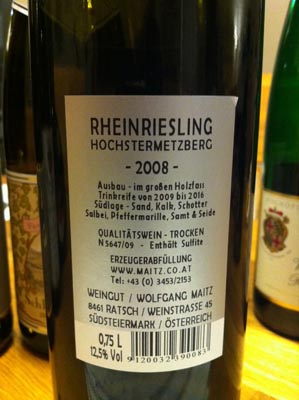
In the end, it was the Austrian that won our hearts and mouths, a 2008 from a winery called Maitz (but known at our table as the Colts, for the evening anyway; I must note that the wine did a lot better over the weekend at our house than the team did on the gridiron, however). And interestingly enough, one of the words that popped into several of our minds when we first sniffed this one was kerosene. But the taste: smooth, mango, butterscotch, full, minerals, pineapple, rich, to highlight a few of the reactions to this very nice bottle. And wouldn’t you know it: it was the most expensive at €20.

So what did we learn? That there’s a lot of decent Riesling to be had, and that you can have it with pretty much anything you want to eat (which therefore makes it a safe bet for our gal Gemma). And the gang loved it. Next up: Cabernets in January – something to look forward to after the holidays.

Post Script:
It actually turned out to be a big wine weekend for Dave and Dory because the Forum Vini was in town. On Sunday afternoon, we rode the U-Bahn to the north of the city and paid €17 a piece to taste wines from all over the world. Such a deal! Shipping wines to private customers is the norm here in Germany, and we found ourselves ordering bottles from South Africa and France, a great rosé Prosecco, and, as it turns out, a Riesling from Austria. So the moral of the story is: if you’re looking for a nice white, give a Trocken (dry) Riesling from Austria a try.